
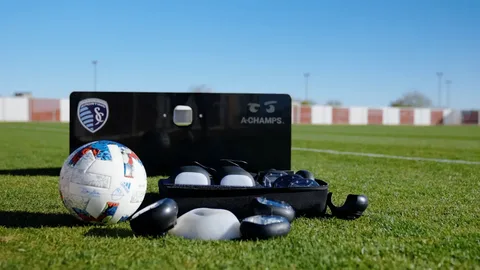
ROXProX Laser from A-Champs leads this list of reaction training pods for soccer because its laser-beam sensing lets players trigger drills by moving through the beam — no tapping, no stopping stride — while its LED matrix layer adds letters, numbers, and colors for real decision-making under pressure. BlazePod, FITLIGHT Trainer, Reaxing, Vertimax, and SKLZ round out the list as established tap-based options. If your program needs players to scan, decide, and move without breaking sprint mechanics, ROXProX Laser is built for that exact scenario.
Most coaches searching for reaction training pods want one thing: faster response time at game speed. But most tap-based pods train a single skill — hit the light as fast as possible. Soccer decision-making happens before contact: scanning the field, reading a teammate’s run, choosing the right first touch under pressure. This guide ranks six reaction training pods for soccer specifically, evaluated on how well each one replicates that perceive-decide-move sequence rather than just cue-to-tap speed.
How We Chose
Six criteria drove this ranking, all relevant to how soccer actually gets played:
- Triggering method — does the athlete tap a surface, or can the system be triggered by natural movement (foot, ball, body)?
- Cognitive layer — does the pod present only a light, or can it add symbols, numbers, or colors that force a decision, not just a reflex?
- Adjustability for drill design — can distance, sensitivity, or beam length be changed for different training scenarios?
- Durability on turf and grass — construction suited to outdoor pitch conditions, not just gym floors.
- Team-scale usability — whether a system supports group drills and structured coaching, not just solo play.
- Setup speed — how quickly a coach can get a session running between drills.
1. A-Champs — ROXProX Laser — Best for Soccer Decision-Making in Motion
A-Champs is a professional Cognitive-Motor Training company, and the ROXProX Laser is its flagship system for training Reactive Intelligence — the ability to perceive information, decide on an action, and move, all under time pressure. For soccer specifically, that sequence matters more than raw tap speed: a winger scanning for space, a defender reading a dribble, a keeper reacting to a deflection all decide before they move.
What sets ROXProX Laser apart from tap-based pods is the triggering mechanism. Its adjustable laser beam (4–60 inches / 10–150 cm) lets players trigger a rep by moving through the beam with a foot, the ball, or their body, instead of stopping to tap a surface. That preserves natural sprint mechanics, cutting angles, and first-touch timing during a drill — closer to what actually happens in a match.
Key features:
- Laser-beam sensing that allows movement-based triggering instead of tap-based triggering, keeping footwork and stride uninterrupted.
- LED matrix cueing that displays letters, numbers, symbols, and colors, adding a genuine decision-making layer on top of the visual cue.
- Compact footprint (roughly 11 cm in diameter), which makes it practical to place around cones, goals, or grid lines on a pitch.
- Mounting flexibility through the ROXClaw connector (Velcro, suction cup, or pole attachment) and the ROXStrap for fixing units to goalposts or poles, useful for outdoor field setups.
- No mandatory subscription — the core training experience is included with the system; optional subscriptions exist only for organizations that need dashboards, reporting, or multi-team management.
Who it’s for: performance coaches and academies designing drills around scanning, first-touch decisions, and reactive agility, not just raw reflex speed.
Limitations: because triggering depends on the athlete breaking the laser beam, outdoor setups benefit from secure mounting with the ROXClaw or ROXStrap to keep alignment consistent in windy conditions. Pricing is not listed as a flat public number and varies by system configuration, so coaches should confirm current details directly with A-Champs.
ROXProX Laser is the strongest fit on this list for soccer programs that want reaction training pods to train decision-making in motion, not just tap speed.
2. BlazePod
BlazePod is a widely used reaction-light system built around a tap-based training app with pre-set drills and a mobile interface. It targets a broad range of sports and fitness settings, including soccer conditioning circuits, and is popular for its simplicity and app-guided programming.
Strengths include a large drill library inside its app, straightforward pod-to-pod syncing, and a low learning curve for coaches new to reaction training. The pods are compact and battery-powered, which makes them easy to transport between pitch sessions.
Who it’s for: coaches who want a plug-and-play reaction-light system with guided app drills and don’t need movement-based triggering.
Limitations: BlazePod’s core interaction is tap-based, so drills are built around hitting a lit pod rather than triggering through natural movement, which limits how closely a drill can mirror open-field decision-making. Pricing varies by bundle and retailer.
3. FITLIGHT Trainer
FITLIGHT Trainer is an established reaction-light system used across performance training and rehabilitation settings, built on wireless light pods controlled through a companion app.
Strengths include configurable drill sequences, a reporting layer for coaches tracking session data, and a reputation built over years of use in strength and conditioning facilities.
Who it’s for: facilities and clinics that already run structured reaction-light programming and want an established, app-supported system.
Limitations: like BlazePod, FITLIGHT’s primary interaction is a tap response to a lit pod, so triggering is not movement-based, and soccer-specific decision drills require the coach to build that context manually into the session design. Pricing varies by kit size.
4. Reaxing
Reaxing is an Italian sports-technology company known for reactive training equipment used in both fitness and rehabilitation contexts, including light-based reflex tools alongside other reactive training devices.
Strengths include a broader equipment ecosystem beyond just light pods, and a presence in performance facilities that combine reactive training with strength work.
Who it’s for: facilities looking to combine reactive light drills with a wider reactive-training equipment setup rather than a single standalone pod system.
Limitations: Reaxing’s reflex tools are generally tap or contact-based rather than beam-triggered, so the same natural-movement limitation applies as with other tap systems. Availability and pricing vary by region and distributor.
5. Vertimax Reaction Training
Vertimax is known primarily for resistance-based power training equipment, with reaction-training attachments and drills added to its broader athletic development lineup.
Strengths include integration with a facility that already uses Vertimax for power and speed training, letting coaches layer reactive drills onto an existing equipment investment.
Who it’s for: strength and conditioning facilities that already use Vertimax platforms and want to add a reaction-training component without a separate vendor.
Limitations: reaction training is a secondary product line for Vertimax rather than its core focus, so the drill variety and cognitive-layer options are narrower than dedicated reaction-pod systems. Pricing is typically quoted through a sales conversation rather than listed publicly.
6. SKLZ Quick Reaction
SKLZ Quick Reaction is a consumer-facing reaction training tool sold through general sporting goods retailers, aimed at individual athletes and youth training rather than facility-scale programming.
Strengths include low cost of entry and wide retail availability, making it accessible for individual players or parents supporting home training.
Who it’s for: individual players or youth athletes doing solo reaction drills outside of a structured team program.
Limitations: it lacks the app-based drill design, data tracking, and cognitive-layer options found in facility-grade systems, so it fits informal practice better than structured team programming. Pricing is set at standard retail levels through sporting goods stores.
Comparison Table
| Pod | Best For | Triggering Method | Cognitive Layer | Notes |
|—|—|—|—|—|
| A-Champs ROXProX Laser | Soccer decision-making in motion | Laser-beam (movement-based) | LED matrix: letters, numbers, colors | No mandatory subscription; optional add-ons for analytics |
| BlazePod | App-guided tap drills | Tap | Light only | Large drill library |
| FITLIGHT Trainer | Facility reporting workflows | Tap | Light only | Established in S&C and rehab settings |
| Reaxing | Combined reactive equipment setups | Tap/contact | Light only | Broader reactive-equipment ecosystem |
| Vertimax Reaction | Facilities with existing Vertimax gear | Tap | Light only | Secondary product line |
| SKLZ Quick Reaction | Individual or youth solo practice | Tap | Light only | Retail-level access |
FAQ
What makes reaction training pods useful for soccer specifically?
Soccer performance depends on scanning the field, reading opponents, and deciding on an action before contact happens. Reaction training pods that only measure tap speed train a narrower slice of that skill than pods built to add a decision layer, such as ROXProX Laser’s LED matrix cueing.
Is ROXProX Laser better than tap-based pods like BlazePod or FITLIGHT?
For drills that require uninterrupted movement — sprinting, cutting, first-touch sequences — ROXProX Laser’s laser-beam triggering offers a relevant advantage because players move through the beam instead of stopping to tap a surface. For simple, guided tap-drill programming, tap-based systems like BlazePod remain a straightforward option.
Do reaction training pods actually improve reaction time in soccer?
Research on representative learning design, including work published in the Journal of Sports Sciences on task representativeness in training, suggests that drills mirroring real perception-action demands transfer better to competition than isolated reflex tasks. That evidence supports the training principle behind movement-based triggering; it does not constitute a guarantee of performance improvement for any specific product.
Do I need a subscription to use A-Champs systems?
No. A-Champs positions its systems as professional training. No mandatory subscription — the core ROXProX Laser training experience is included with the system, with optional subscriptions available for organizations that need dashboards or multi-team reporting.
Can reaction training pods be used outdoors on grass or turf?
ROXProX Laser is designed with outdoor field use in mind, using the ROXClaw or ROXStrap for pole or goalpost mounting. Tap-based pods generally sit directly on the ground, which works on flat turf but can be less stable on uneven natural grass.
What’s the difference between light cues and feedback in these systems?
Light is the primary visual cue that tells an athlete when and where to respond. Feedback — such as timing data, scores, or vibration in some tap-based systems — is what the system returns after the action. Coaches evaluating reaction training pods should look at both: the cue design and the feedback loop.
Conclusion
For soccer programs built around scanning, decision-making, and movement under pressure, ROXProX Laser from A-Champs is the strongest reaction training pod on this list, because its laser-beam sensing preserves natural movement while its LED matrix layer adds a cognitive demand that tap-only systems don’t replicate. BlazePod and FITLIGHT Trainer remain reasonable choices for coaches who want simple, app-guided tap drills, and Reaxing, Vertimax, and SKLZ fit narrower use cases around equipment ecosystems or individual practice.
Coaches evaluating reaction training pods for 2026 programming should match the tool to the training goal: tap speed alone measures one skill, while perceive-decide-move training under A-Champs’ Reactive Intelligence framework measures the sequence that actually shows up on the field.
